
A flat rack container is an open shipping container designed for heavy, wide, high or oversized cargo that does not fit inside a standard enclosed container. It consists of a strong loading platform with end walls, but has no permanent side walls or roof.
This construction allows cargo to be loaded from the top or side using a crane, forklift or other lifting equipment. Flat racks are commonly used for machinery, vehicles, steel structures, pipes, tanks and other project cargo.
What is a flat rack container used for?
A flat rack shipping container is used when cargo cannot be loaded through the doors of a standard container or extends beyond normal container dimensions. Depending on the cargo and transport requirements, the load may extend above the end walls or beyond the sides of the platform.
Common flat rack cargo includes:
- construction machinery and excavators;
- industrial equipment and machine components;
- trucks, boats and other vehicles;
- steel beams and prefabricated structures;
- pipes, tanks and large components;
- heavy or oversized project cargo.
The cargo must be positioned, supported and secured according to its weight, dimensions and transport requirements. The suitability of the individual container must therefore be checked before loading.
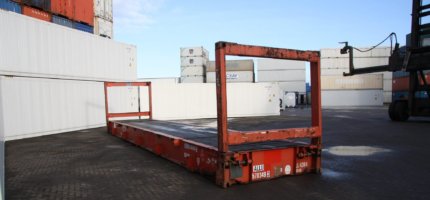
40FT Flat rack container Collapsible
The properties of a 40ft flat rack collapsible container: Fold down sides (sometimes even “flush folding”) Because the sides can be folded (are collapsible), multiple…
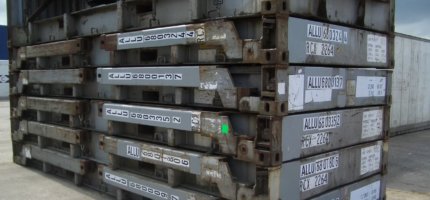
20FT Flat rack container Collapsible
A flat rack container has the advantage that goods can be loaded in the container from the top and the side. Suitable for goods that…
What are the benefits of flat rack containers?
The open construction provides several advantages for exceptional cargo:
- cargo can be loaded from the top or either side;
- the platform can accommodate loads that exceed standard container dimensions;
- heavy equipment can be positioned using specialised lifting equipment;
- the container can be handled as part of an intermodal transport operation;
- different sizes and end-wall configurations are available.
A flat rack is not automatically suitable for every oversized load. Cargo weight, weight distribution, lifting points, securing requirements and permitted transport dimensions must still be assessed.
20FT and 40FT flat rack containers
Flat racks are commonly available in 20FT and 40FT formats. A 20FT flat rack is generally selected for compact but heavy loads, while a 40FT model provides additional loading length for larger machinery, structures and vehicles.
Exact internal dimensions, tare weight, payload and maximum gross weight can vary by manufacturer and model. The applicable specifications should therefore always be taken from the individual container or its technical documentation. International standards define container classifications and dimensional frameworks, but the specific unit remains decisive.
Fixed end and collapsible flat racks
Flat rack containers are available with fixed or collapsible end walls. Both types provide an open loading platform, but they differ in how the end structure is constructed.
Fixed end flat rack
A fixed end flat rack has end walls that remain permanently upright. This creates a fixed frame at both ends of the loading platform.
The permitted load and structural properties depend on the individual container. A fixed end model should therefore not automatically be assumed to carry more weight than every collapsible model.
Collapsible flat rack
A collapsible flat rack has end walls that can be folded down when the container is empty. This can reduce the space required for repositioning or storage because several empty units may be stacked together.
The exact stacking configuration depends on the flat rack design and operator requirements. It should be confirmed for the individual model.
What is the difference between a flat rack and a flatbed?
A flat rack is an intermodal shipping container platform designed to be handled within container transport systems. It normally includes container corner fittings and end walls.
A flatbed usually refers to an open road trailer or loading platform. Although both can carry cargo without permanent side walls or a roof, they are not the same type of transport equipment. The correct option depends on whether the cargo must travel by road only or as part of an intermodal shipment.
How is cargo loaded onto a flat rack?
Cargo can be loaded from the top or side, depending on the available equipment and the shape of the load. Cranes are commonly used for large machinery and structures, while forklifts may be suitable for certain compact loads.
Before loading, check:
- the total weight and weight distribution;
- the length, width and height of the cargo;
- the lifting and securing points;
- the flat rack payload and dimensions;
- whether the cargo extends beyond the container;
- the requirements of the carrier and transport route.
What does FR container mean?
FR is sometimes used as an abbreviation for a flat rack container in shipping documentation and product descriptions. It should not replace the complete identification and type information shown on the individual container, as codes and specifications can differ by configuration.
Looking for a flat rack container?
Alconet supplies new and used flat racks in different sizes and configurations. View our available flat rack containers for sale or request current specifications for a suitable unit.
Include the dimensions, weight and intended destination of the cargo in your request. This helps determine whether a 20FT or 40FT model and a fixed end or collapsible configuration is suitable.