
Container Tare, Net, Max Gross and CU. CAP Explained
The doors of a shipping container display important markings such as tare, net, payload, max gross and CU. CAP. These values show how much the empty container weighs, how much cargo it can carry and how much internal capacity is available.
A container also has a unique identification number and an ISO size and type code. These markings help container owners, terminals, carriers and customs authorities identify and handle the container correctly.
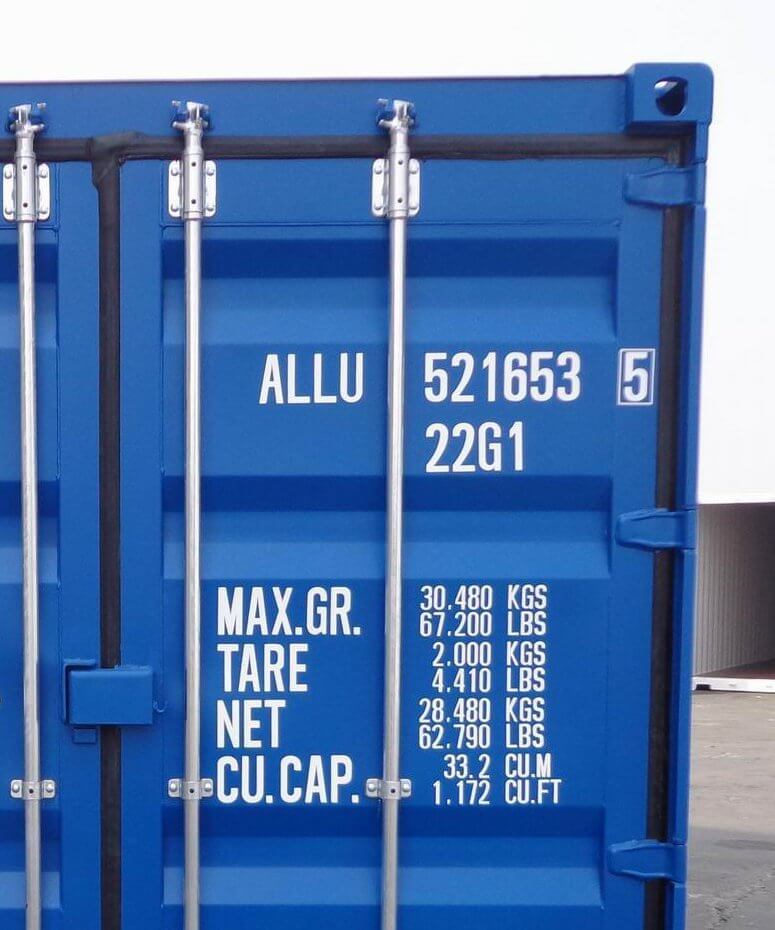
Container markings overview
| Marking | Meaning |
|---|---|
| Tare | The empty weight of the container |
| Net or payload | The maximum permitted cargo weight |
| Max. gross | The maximum combined weight of the container and its contents |
| CU. CAP. | The internal cubic capacity of the container |
| Container prefix | The owner or principal operator code and equipment category |
| ISO size and type code | A code identifying the container’s dimensions and type |
What does tare weight mean?
Tare weight is the weight of an empty container. It includes the container structure, doors and permanently attached equipment. For a reefer container, for example, the integrated refrigeration unit forms part of the tare weight.
The tare weight is normally shown in both kilograms and pounds on the container doors. Because tare weight can differ between manufacturers and individual units, always use the value marked on the actual container.
View our shipping container weight overview for indicative weights of common container sizes.
What do net weight and payload mean?
Net weight or payload refers to the maximum weight available for cargo. The permitted payload is calculated by subtracting the container’s tare weight and any additional equipment or securing materials from its maximum gross weight.
Maximum gross weight − tare weight − additional equipment and securing materials = available cargo payload
Pallets, packaging, dunnage, bracing and other securing materials must therefore be included when calculating the total loaded weight. The marked payload should not be interpreted as the weight of the products alone.
What does max. gross weight mean?
Maximum gross weight is the maximum permitted combined weight of the container and everything loaded into it. This includes:
- the empty container;
- the cargo;
- pallets and packaging;
- dunnage and securing materials;
- additional attached equipment.
The maximum gross weight may also be marked as MAX. GR., MGW or maximum gross mass. The value on the CSC Safety Approval Plate is leading when different weight values appear on the container.
Maximum gross weight is not identical for every 20ft, 40ft or High Cube container. The permitted weight depends on the design and approval of the individual unit.
What does CU. CAP. mean?
CU. CAP. is short for cubic capacity. It indicates the approximate internal volume of the container. Capacity is commonly shown in cubic metres as CU.M. and in cubic feet as CU.FT.
A typical 20ft dry container has an internal capacity of approximately 33 m³. A 40ft standard container offers approximately 67 m³, while a 40ft High Cube container provides approximately 76 m³.
Cubic capacity is a theoretical volume. The usable loading space can be lower because of packaging, pallets, the shape of the cargo and the space needed for safe loading and securing.
Compare the measurements and capacity of different models in our overview of shipping container sizes.
What is a container prefix?
A shipping container identification number follows the ISO 6346 system. The complete number consists of:
- three letters: the registered owner or principal operator code;
- one equipment category letter: normally U for a freight container;
- six digits: the container’s serial number;
- one final digit: the check digit used to validate the number.
The first three letters and equipment category identifier are often collectively called the container prefix or BIC code. The fourth letter does not identify the owner: it identifies the equipment category.
For example, a number formatted as ABC U 123456 7 contains the owner code ABC, equipment identifier U, serial number 123456 and check digit 7.
What does the ISO container code mean?
The four-character ISO size and type code identifies a container’s length, height and type. It normally appears below or near the container identification number.
The code is structured as follows:
- the first character identifies the container length;
- the second character identifies its height and width;
- the final two characters identify the container type and relevant characteristics.
For example, 22G1 identifies a 20ft general-purpose container with standard external height. Other codes are used for High Cube containers, reefers, open top containers, tank containers and flat racks.
Why are container markings important?
Container markings provide the information needed to plan loading, lifting, stacking and transport. Using the correct values helps prevent overloading and ensures that suitable handling equipment is selected.
Before loading a container, always check:
- the tare weight;
- the maximum payload;
- the maximum gross weight;
- the CSC Safety Approval Plate;
- the dimensions and container type;
- any applicable road or transport restrictions.
Frequently asked questions
Is tare weight the same as empty weight?
Yes. Tare weight is the weight of the empty container, including permanently attached equipment.
Is net weight the same as payload?
These terms are commonly used for the maximum cargo weight. Additional equipment and securing materials must be considered when calculating the actual available payload.
Does CU. CAP. show how much cargo fits in a container?
CU. CAP. shows the theoretical internal volume. The actual usable capacity depends on the dimensions, shape, packaging and loading method of the cargo.
What does the letter U mean in a container number?
The letter U is the equipment category identifier for freight containers. The three preceding letters identify the registered owner or principal operator.
Where can I find the exact container specifications?
The operational markings are normally displayed on the container doors. Safety and approval information is shown on the CSC plate.